


In Practical Homeopathy®, we consider symptoms to be gifts. They quickly inform us which parts of our body are affected by a condition and vividly demonstrate the effects it is causing.
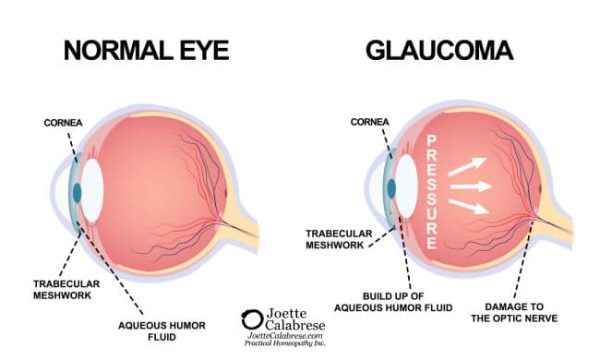
Yet, then there’s glaucoma. As intraocular pressure increases in the eye, it damages the optic nerve.
However, one may not notice any symptoms at all. As the Mayo Clinic, a repository of conventional medical information, says, “Many forms of glaucoma have no warning signs. The effect is so gradual that you may not notice a change in vision until the condition is in its later stages.”
Testing Is Key to Diagnosis
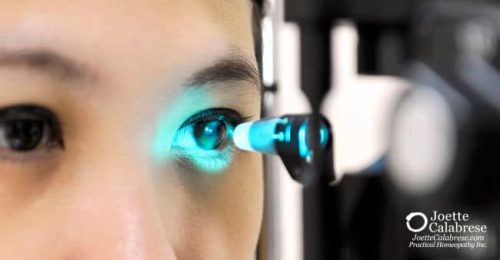
The “later stages” of glaucoma are generally vision loss and even blindness. To avoid that eventuality, a simple, non-invasive eye pressure test during a routine eye exam can yield important information.
It would be useful to have an accurate determination of eye pressure. Unlike with my tongue-in-cheek image, we are unable to see when our eyes are a little over-inflated (experiencing higher than normal pressure). And we certainly can’t feel internal pressure in our eyes.
However, if the results of an eye pressure test sound the alarm, homeopathy stands ready to right the ship.
Homeopathic Argentum nitricum for Glaucoma
The Banerji Protocol of Argentum nitricum 200C and Calcarea carbonica 30C would be a strong homeopathic consideration for glaucoma. Both homeopathic medicines would be utilized twice daily; however, they would not be taken simultaneously.
As I teach my Academy students, it’s interesting to note that Argentum is NOT one of the most highly recommended medicines as listed in Dr. Robin Murphy’s MetaRepertory (Fourth Edition) on page 713. Instead, it’s listed as a third-level medicine. But, my friends, my money is on the Banerjis. Every. Single. Time.
Keep in mind that glaucoma is generally not a condition that resolves quickly, as an ear infection might. In this chronic condition, improvement occurs over a more extended period of time.
In a case from my clinical practice, it took many, many, many months before improvement ensued. It could even take up to a year, depending on the severity. But take heart. I have been surprised more than once when improvement comes in cases deemed seemingly “hopeless” by conventional medicine.
I encourage you to read What Else? The Sweeping Ability of Homeopathy for more specifics on the assessment of conditions after beginning a homeopathic regimen.
Testing Is Key to Assessment
Yet, how do we carefully observe for changes in the condition if we couldn’t even tell we had it in the first place?
Repetitive testing. We want to track the pressure numbers as we progress through the homeopathic schedule. Those tests are a valuable measure of success in addressing glaucoma. This is certainly one time when we can’t just decide that we “feel” better. We need the evidence that tests can reveal.
As the subsequent pressure numbers improve, the schedule can be backed off from the twice-daily schedule and halt when very much better.
It goes without saying that it would probably be the rare ophthalmologist who would say, “Wow, you’re improving!” They probably wouldn’t be able to wrap their minds around it. But who can argue with the numbers?
However, as in any condition, if no improvement has ensued, then we would most likely back away from this remedy and pivot to another (perhaps under the expert care of a well-trained Practical Homeopath™).
Plus, Get Back to the Basics
In fifth grade, we learned which foods are beneficial for different parts of the body (e.g., milk for bones, etc.). Now, I’m not an expert in glaucoma. However, my layperson’s opinion is to go back to the fifth-grade basics, in addition to our well-chosen homeopathic medicine.
Fish oil is excellent for eye health. However, you know I’m not a fan of manufactured, often synthetic supplements, so let’s get our fish oil from the fish. Then, for good measure, add some wild salmon and other wild fish (such as mackerel and sardines) to the weekly diet.
Want to try an unusual superfood? I suggested cod fish livers — not the oil, but the actual livers — to one of my team members for her eye issues (along with Argentum nitricum 200C and Calcarea carbonica 30C, of course), and she experienced significant improvement. Plus, she fell in love with their unctuous taste. They’re so rich that only a small bite daily is necessary, but she found it hard to resist the occasional extra nibble.
They really are delicious. (My favorite brand is King Oscar, but that brand is becoming increasingly difficult to find. Amazon has several other brand selections.)
Sunshine can also be helpful for eye conditions. I don’t mean staring into the sun; naturally, that would not be prudent. However, getting out into the sun allows one’s body to manufacture natural vitamin D (so much better than a supplement). There is a growing body of research correlating higher levels of vitamin D with eye health, so why not? Besides, getting into the great outdoors is fun, relaxing and healthy in many ways.
Homeopathy works, and a few added common-sense dietary and activity changes can also be a great adjunct.
Pass on the good news of Practical Homeopathy®!
Warmly,
P.S. Consider the security of having a network of like-minded friends to call in the middle of the night when a loved one is suffering, and you’re freaking.
My Gateway to Practical Homeopathy®: A Guided Study Group Curriculum is your entrance to a self-reliant yet well-supported future. With Gateway to Practical Homeopathy®, you will get started on the right foot, learning homeopathy skills you can use right away, as well as connecting with mothers and others who will be there when you need a little help.
By stepping through the Gateway to Practical Homeopathy®, you’ll be prepared when your family experiences the bumps, bruises, scrapes, fevers, flu and more that life regularly throws our way.


Thank you for always keeping us up to date and helping us deal with various maladies and even potential maladies by arming us with the correct remedies to deal with “whatever ails us”.
Thanks for this! Would the protocol differ for glaucoma caused by eye pressure that is too low?
I am going to try! I’m at the beginning phase of glaucoma and due an eye exam. I heard the numbers for eye pressure but never asked why it matters. I think your article information is the perfect start for me. Thank you for this article.
If you would like a deep dive into nutrition taking you down a path that is relatively new, then look into the low Vitamin A diet. It just might be that Vitamin A is not really a vitamin at all! It’s a toxin. Fish oil and salmon are high in Vitamin A and I personally would avoid them. This thinking came about from a man named Grant Genereux who in his early 50’s was very ill. His kidney doctor told him to get his affairs in order as he had about 5 years left to live. Long story short, after a doctor gave him a short list of foods to avoid for his torturous eczema, he did some research and discovered that the one thing these foods had in common was Vitamin A. He put himself on a very low Vitamin A diet and cured his eczema in two years, reversed stage 4 kidney disease completely, re-mineralized his teeth and after 10 years on the diet, now a man in his 60’s, his vision is perfect all without Vitamin A! Look him up. His is a very interesting story. He has written 3 books and gives them away for free on his website. The first book explains how he came to the conclusion he did about Vitamin A and is well worth the read. Do yourself a favor and before you embark on fish oil and salmon, do your research. Grant found the original rat study from the early 1900’s and discovered that the low A diet they fed the rats really wasn’t low A. It was high A. This means that all the symptoms the rats showed and were believed to be from low Vitamin A were actually symptoms of high Vitamin A. Let that sink in and you will start to realize our current thinking about Vitamin A maybe all wrong.
hmm, will have to check that out for myself
Polly, this is really interesting info – thank you for sharing it! Hope you are doing much better – miss your work! LL
There are two types of Vitamin A – one from plants and one from animals. Vitamin A from animals (a.k.a. retinol) is the kind that is very helpful to our bodies. Many receptor sites won’t work properly without it. Synthetic vitamin a is toxic, yes, and should be avoided like the plague.
Thank you, Polly … super interesting and invaluable post. Adding this into my studies and explorations now. Cheers to you!
Thanks for help me
Hi Joette,
would Argentum nitricum 200C be also your first choice for retinal thinning? Is it possible to reverse the retinal thinning by using homeopathy? Is it possible using homeopathy at least to stop the process of retinal thinning? I highly appreciate your opinion.
The thing about homeopathy is that we don’t always know how far it will act for a certain condition BUT…
the best part is that given there are no side effects and the cost is low, we can always give a medicine its due time without much worry.
One hint is that its best to allow medicines used for chronic condition to be taken for at least 6-8 weeks followed by an assessment and carried on further if more work remains.
Hi Joette,
Are there any other homeopathic medicines that would be worth giving them a try when thinning retina condition? Yes, I do know homeopathic medicines need those at least 6-8 weeks when treating a chronic condition.
Are you saying that you’ve used this protocol, given its due and have not had any improvement?
Thanks so much for this article and your wise response and reminders to Petra. I also appreciate your opinons. Always insightful!
I see Calcarea carbonica 30C recommended for glaucoma & Calcarea carbonica 200C recommended for cataracts. I have both cataracts & glaucoma. Should I take both remedies or just one? If just one, which one would you recommend?
Thank you!
I teach my students to focus on the most sobering condition and use the protocol accordingly. This will allow the medicine that’s common to both to act even at a different potency.
By the way, cataracts are often related to high blood sugar.
Consider removing carbs and sugar from the diet.
Thank you. I have cut most sugar & carbs out of my diet for years, & my doctor says my cataracts are of no concern at this point – normal for my age. I may or may not have glaucoma, but I’m at high risk, so my doctor has me on eye drops. Would glaucoma be the one to treat first then?
I don’t know what you mean by high risk but more importantly, given that homeopathy is not supplementation nor vitamin therapy, we don’t use homeopathic medicines for a potential chronic condition. The condition must already exist.
My doctors said there’s no clear line of when glaucoma starts. According to what my husband just read, high pressure causes nerve damage, but they don’t call it glaucoma until the nerve has been permanently damaged. My doctor saw something a little suspicious a few years ago that’s gotten a little worse looking. My corneas are thin. My pressure is a little high. My Dad is nearly blind from glaucoma. But I don’t have any nerve damage yet, so I have not been diagnosed with glaucoma. My doctor wants my pressure down now to help prevent nerve damage/vision loss in the future, & eye drops are currently keeping pressure lower. So should I take the glaucoma remedy & see if there are changes that enable me to get off the medication, or do I treat for cataracts because the test shows I definitely have them?
(For some reason the captcha box won’t show up when replying to a comment, only when adding a new one)
Your rationale may be more in alignment with the use of the medicines but unfortunately I’m not able to offer specific advice.
Let me at least say that anytime we use a homeopathic medicine it should be assessed regularly.
Also, consider removing carbs from the diet.